
Insights into the Completed Research Project 6G-ReS
Insights into the Completed Research Project 6G-ReS

The 6G-ReS project has now concluded. Funded by the Federal Office for Information Security (BSI), the aim of the project was to strengthen the trustworthiness of future sixth-generation (6G) mobile communication systems. To achieve this goal, the Barkhausen Institut (BI) worked with several partners to explore ways of improving the security and resilience of these systems.
In the following interview, Dr.-Ing. Stefan Köpsell, head of the Trustworthy Data Processing research group at the BI, reflects on the 6G-ReS project and the work carried out to enhance the trustworthiness of future 6G networks. The conversation places the project’s results in the broader context of complex digital infrastructures and highlights their potential relevance for the security of future communication systems.
What results or insights emerged from the project?
The project addressed several aspects of security and resilience in 6G systems:
- A software tool was developed that uses machine learning techniques to identify potential threats and risks based on the specification of a mobile communication system.
- The researchers designed solutions that enable secure execution of 6G software components even on untrusted cloud infrastructures. These approaches are based on the concept of confidential computing.
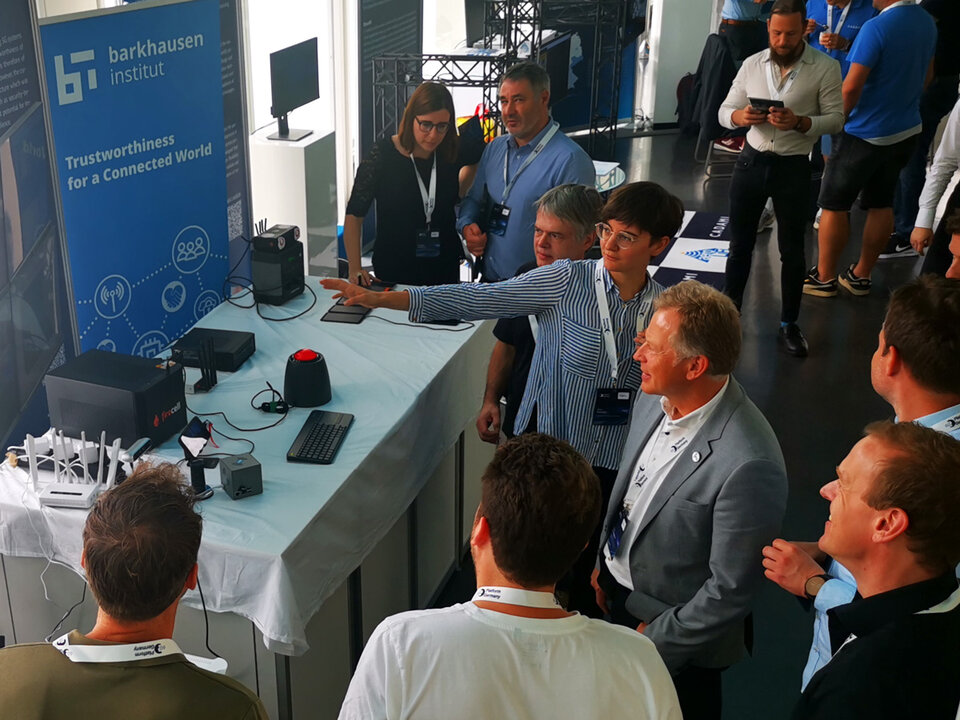
- The team also designed a dedicated hardware and software platform known as a security gateway. This platform enables mobile communication systems and application software to run securely. Such a system could, for example, support the operation of a local 6G network, often referred to as a campus network.
- In addition, the project developed solutions capable of detecting attacks that intentionally disrupt radio transmission, so-called jamming attacks.
What will happen to the research results?
The project results have been published in scientific venues, and some outcomes are already being incorporated into product development by the project partners. This includes, for example, the gateway platform developed with the partner secunet, as well as solutions related to confidential computing developed with Scontain.
Some of the developed tools are also available to the research community as open-source software. This includes an analysis tool designed to identify security vulnerabilities in real-world mobile communication systems. It is available here on github: UE based 5G-Pentesting Framework
In addition, the follow-up project RESMEDTEC has recently been approved. Over the next three years, it will continue the work started in 6G-ReS, with a new focus on strengthening security and resilience in medical data processing environments such as hospitals and clinical systems.
How will citizens, businesses, or other institutions benefit from the project results?
For citizens, the results of the project are not immediately visible. In the medium to long term, however, they contribute to strengthening the trustworthiness of the next generation of mobile communication systems. This benefits everyone, as 6G systems are expected to form a key backbone of future digital infrastructures on which many other services and systems will depend.
The project was funded and actively supported by the Federal Office for Information Security (BSI). Since the BSI is also involved in the standardization of 6G technologies, insights gained from the project may influence future standardization efforts as well.
What did the project mean for you and your research in particular?
For my research group and me, the project provided an opportunity to explore exciting research questions related to the security and resilience of 6G systems together with highly skilled and motivated partners. We were able not only to develop concrete solutions but also to significantly expand our knowledge of 6G technologies.
The collaboration with industry partners was particularly valuable. 6G systems are extremely complex, and many stakeholders are involved in their development and operation. Our work could therefore only represent a small contribution. Nevertheless, it leaves us with the satisfying feeling that we were able to contribute something meaningful to society.
Funded by: