
Zum Inhalt

Trustworthy Physical Interfaces
Electromagnetic waves are the foundation for radio communication and for many sensor applications (e.g., radar, spectroscopy) in the Internet of Things. Technical rules and standards must be defined to ensure that all processes run smoothly. These standards, some of which have been in place for decades, define how devices should communicate and work together. They ensure that everything functions properly and that devices from different manufacturers are compatible with each other. Through our research, we identify challenges for trustworthiness. We can influence standardization in a timely manner and raise awareness within the research community accordingly.

The research groups Radio Frequency Design Enablement and Wireless Connectivity and Sensing are collaborating on two topics that are particularly significant for the trustworthiness of future systems:

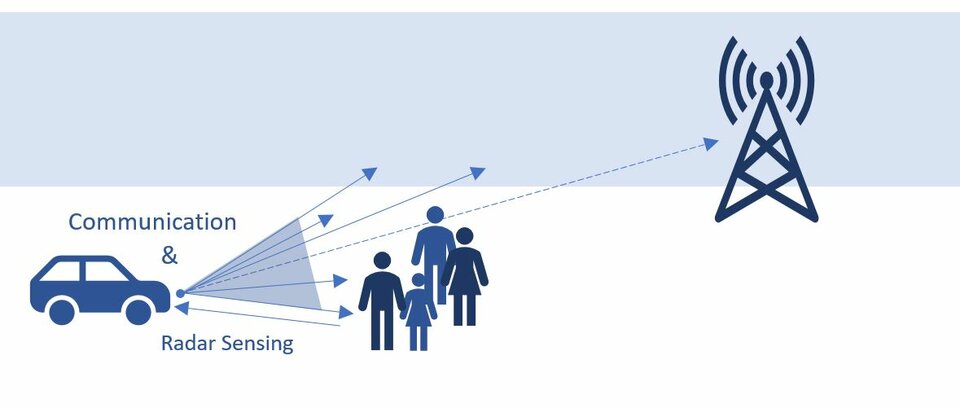
  1. Joint Communications and Sensing (JC&S): This technology combines radio communication and radar systems. It uses the same electromagnetic waves both to transmit information and to capture environmental data. It is expected to be deployed in the upcoming 6G mobile communication standard. Our goal is to establish the foundations for the trustworthiness of JC&S.
     
  2. Physical Layer Security: Here, the combination of radio communication and sensor technology is deliberately used to enhance the trustworthiness of data transmission. From today's perspective, the resulting methods cannot be "broken" even by future quantum computers.

Projects

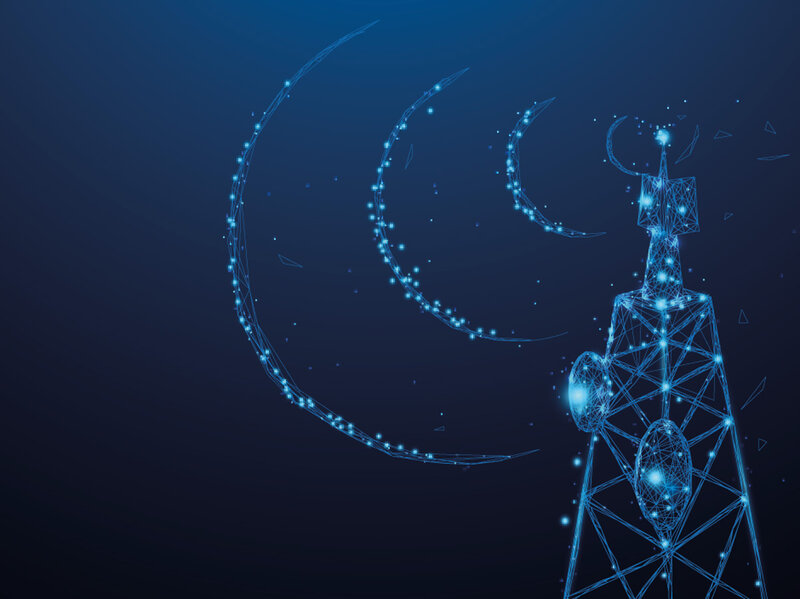
Telecommunication signaling device in bright light blue on a dark blue background
15.06.2024

ACES – Accelerating Communication through Environmental Sensing

In the ACES project, the BI explores how radar and communication technologies can enhance cellular networks. By integrating environmental sensing, base stations can detect obstacles and optimize signal transmission in real time. The Barkhausen Institut is developing simulation tools, mapping algorithms, and a measurement system for real-world testing. (Project duration: 06/2024 – 12/2025)

Read more

01.01.2024

INSTINCT: Redefining 6G Connectivity

How will mobile communication evolve in the future? The EU project INSTINCT is developing groundbreaking 6G technologies—ranging from intelligent surfaces to AI-driven sensors. The Barkhausen Institut is contributing by researching secure communication solutions for a connected world. (Duration: 01/2024 – 12/2026)

Read more

In the backgrount you see the silhouette of a city by night. In the foreground there is a net of glowing beams and some symbols e.g. a lightbulb. Then there is a big white circle with a blue filling and white text that says "6G".
01.01.2024

6G-SENSES: 6G Connectivity with Radio Technologies

The 6G-SENSES project explores groundbreaking wireless technologies such as cell-free mobile networks and JCAS (joint communication and sensing) to revolutionize 6G connectivity. With innovative solutions like reconfigurable intelligent surfaces and millimeter-wave antenna systems, the Barkhausen Institut enhances energy efficiency and precise environmental sensing. (Duration: 01/2024 - 12/2026)

Read more

01.01.2023

HiCONNECTS - Heterogeneous Integration for Connectivity and Sustainability

The project HiCONNECTS aims to overcome two of the most important obstacles of the current state of the art: the transmission of Internet of Things data over the IT network and the sensing of objects to enable "Highly Automated Driving". Barkhausen Institut contributes by developing Radio Frequency Antennas for automotive radars and focusing on integration of the mmWave antennas into radar chipsets. (Duration: 01/2023 - 12/2025)

Read more

01.01.2023

Hexa-X-II: Secure 6G Communication for the Future

As part of the Hexa-X-II project, the Barkhausen Institut is developing security solutions for the next generation of 6G communication. The focus is on physical layer security, data privacy for mission-critical communication, and automated security decisions. With these approaches, the institute is strengthening the trustworthiness and efficiency of future 6G networks. (Duration: 01/2023 - 06/2025)

Read more

15.11.2022

KOMSENS-6G

The goal of KOMSENS-6G is to add another core functionality to the 6th generation (6G) mobile communications system: radio sensing. BI will develop radio frequency hardware for Joint Communication and Sensing and will also focus on security and privacy of such systems. (Duration: 11/2022 - 11/2025)

Read more

01.10.2022

6G-ICAS4Mobility - Combining communication and radar?

The aim of ICAS4Mobility is to combine communication and radar and integrate them into a common system for the future 6G mobile communications standard. Barkhausen Institut is investigating privacy aspects and options for securing captured sensor data against manipulations. (Duration: 10/2022 - 09/2025)

Read more

Zu sehen ist ein Antennensystem stimmungsvoll mit blauem Licht inszeniert.
01.01.1970

MetaBoost: Smart Antennas for the Next Generation of IoT

The MetaBoost project develops compact and energy-efficient antenna systems for high-frequency IoT applications. Using metamaterials and 3D-printed lens structures, the project enables beam-steering functionality critical for future wireless communication systems.
(Duration: 2020 – 2022)

Read more

Publications

Zum Seitenanfang