
BI researchers were granted patent for compact antenna technology
Researchers at the Barkhausen Institut (BI) were granted a patent from the German Patent and Trade Mark Office for a new class of compact antenna designs that combine multiple antennas in a single structure. This technology could enhance future wireless communication systems. The invention was developed by Dr. Shahanawaz Kamal and supervised by Dr. Padmanava Sen from the institute’s RF Design Enablement research group. The patent was issued on 27 November 2025.
Antennas are essential components of wireless communication systems because they transmit and receive signals between devices. As future communication networks must handle increasing numbers of connected devices and data streams, antenna systems need to process multiple signals simultaneously while remaining compact enough for integration into modern devices.
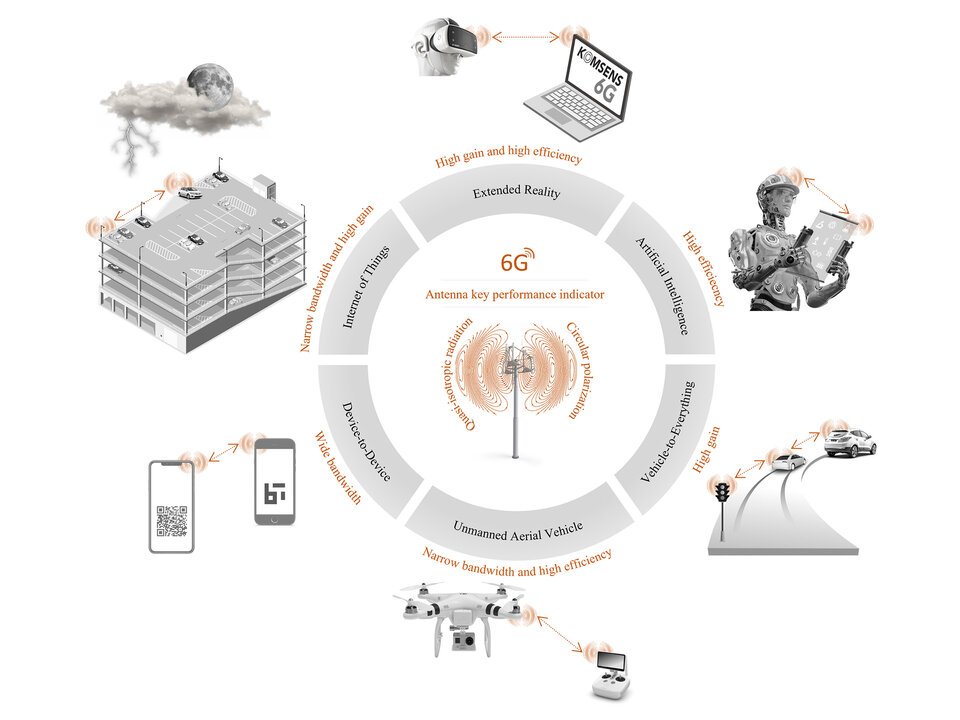
The patented designs combine several structural elements, including specially shaped zig-zag transmission lines, metamaterials, and structured ground planes, that shape how radio signals spread across the antenna. Together these elements enable antenna systems that can generate both linearly and circularly polarized isolated signals. This means the antenna can transmit different signal orientations without them interfering with each other. This capability is particularly relevant for emerging wireless paradigms such as integrated sensing and communication, where radio signals are used not only for data transmission but also for environmental sensing.
Compared with many existing multi-antenna concepts, the proposed designs offer a broader usable bandwidth for signal isolation and polarization while maintaining a compact planar structure consisting of two layers. This architecture simplifies manufacturing and makes the antennas suitable for large-scale production.
Another key feature is the exceptionally wide circular polarization bandwidth achieved by the design. That means the antennas can maintain this signal property over a broad frequency range. The antennas operate in the 6 GHz frequency range and were developed with future communication systems in mind.
Potential application areas include connected vehicles, drones, extended-reality devices, intelligent robotic systems, and device-to-device communication in Internet-of-Things environments.
The research is connected to the project Perceptive communication networks with integrated sensors for 6th generation mobile communications (KOMSENS-6G), funded by the Federal Ministry of Research, Technology and Space (BMFTR).
For further reading on the subject please see: Printed multiple input multiple output antennas powered by passive metamaterial and defected ground for diverse sixth generation applications.