
Hexa-X-II Concludes with Advances in Secure 6G Chip Design

An interview on the outcomes and insights of project Hexa-X-II
As part of the EU flagship project Hexa-X-II, the Barkhausen Institut (BI) contributed to advancing several key aspects of future 6G communication security.
In this interview, Sebastian Haas, researcher at the BI, shares insights into the institute’s work on developing trustworthy chip architectures within the project's scope. This discussion highlights significant progress in creating secure hardware and operating system designs that will be critical for future 6G devices. In addition, the project also explored complementary areas essential for comprehensive 6G security and trustworthiness, reflecting the multifaceted approach taken by the research partners.
What were the main scientific goals of the project?
In Hexa-X-II, we investigated security and privacy aspects in the chip’s hardware, software, and operating system of 6G mobile communication devices. The main challenge is to provide a design that is trustworthy while meeting requirements in terms of performance and energy consumption at the same time.
What results or findings have emerged from the project?
Altogether, three research groups from the BI worked on the project, each with different areas of expertise.
In the Scalable Computing Hardware research group, we introduced a trustworthy chip architecture that addresses the security concerns in 6G devices on the hardware, software, and operating system level. Based on this architecture, we proposed a new concept of integrating hardware accelerators to meet performance and processing resource requirements of applications in 6G mobile devices.
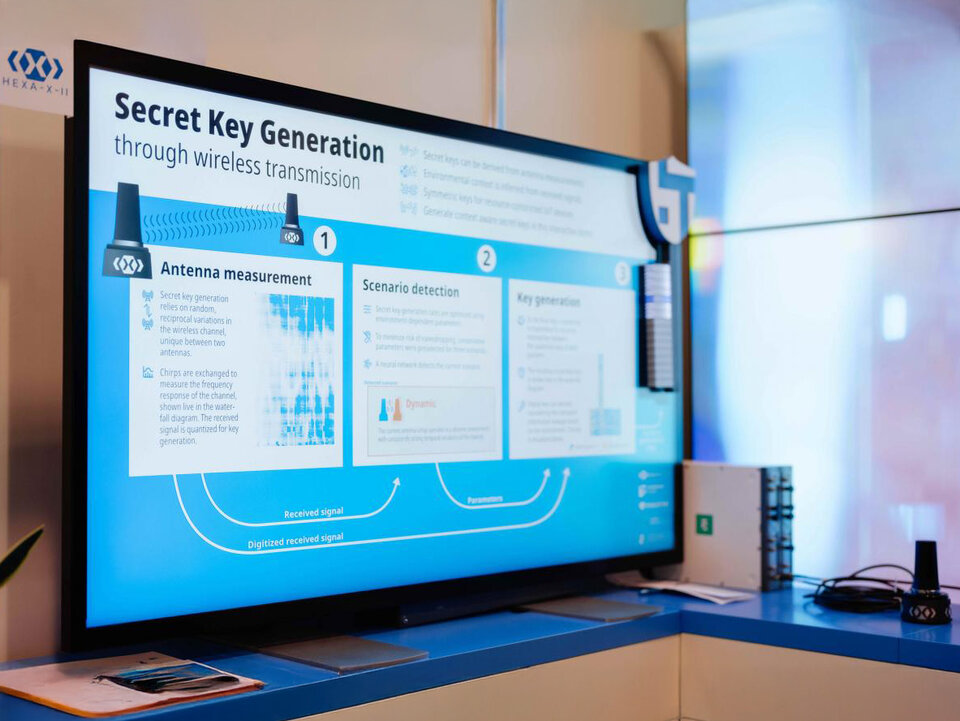
The research group Wireless Connectivity and Sensing collaborated with the Connected Robotics Lab to develop a demonstrator for context-based generation of secret keys for secure device-to-device communication. The wireless signals received by the devices are influenced by the physical properties of the environment, for example, through reflection or scattering. These signals can be converted at both devices into secure bit sequences, which can then be used for encryption. The demonstrator shows how two devices exchange signals, capture environmental context, and generate secret bits from it, which are visualized in the form of a physical key.
The research group Trustworthy Data Processing focused its work on privacy and security aspects of the upcoming radar sensing feature of 6G systems. To this end, they conducted an in-depth threat analysis. Based on the results, they proposed a mitigation solution to reduce the security and privacy risks associated with radar sensing.

What will happen with the research results?
Research results were published at scientific conferences and project deliverable reports. Since the results primarily introduced initial concepts of a secure chip architecture, we will continue working on the topic in follow-up projects to further improve the trustworthiness in 6G devices.
Are the results available as open source to the scientific community?
Yes. Our general secure chip architecture, including the operating system, has been published as open source on GitHub:
github.com/Barkhausen-Institut/M3
github.com/Barkhausen-Institut/M3-hardware
How do citizens, businesses, or other organizations benefit from the project outcomes?
The evolution of new 6G mobile networks will enable more and more features in smart systems and communication devices that influence our daily decision-making processes, making their reliability crucial. Failures in such systems do not only disrupt functionality but can also pose significant risks to human safety. Therefore, research is important that addresses vulnerabilities and strengthens the trustworthiness of future 6G mobile devices.
What does the project mean to you and your research specifically?
At the BI, we conduct cutting-edge research on the trustworthiness of general networked electronic systems. Since the Hexa-X-II project focuses on 6G mobile networks specifically, we had a unique opportunity to investigate our research concepts with focus on upcoming 6G devices and their requirements. Knowledge exchange with project partners, who contribute expertise on the application level, allows us to broaden our know-how and adapt our research directions.